Vin Consultancy

Start Your Education Journey in Canada

Canada is one of the most popular destinations for skilled professionals, students, and families looking for permanent settlement abroad. With its strong economy, high standard of living, and transparent immigration system, Canada offers one of the best pathways to permanent residency.
At Vin Consultancy, we provide expert guidance for Canada immigration, ensuring a smooth and successful application process.

canada-maps

Study in Canada

Canada is one of the most preferred destinations for international students due to its world-class education system, multicultural society, excellent quality of life, and strong career opportunities. With globally recognized universities and colleges, affordable education, and pathways to permanent residency, Canada offers students a bright future both academically and professionally.

About Canada

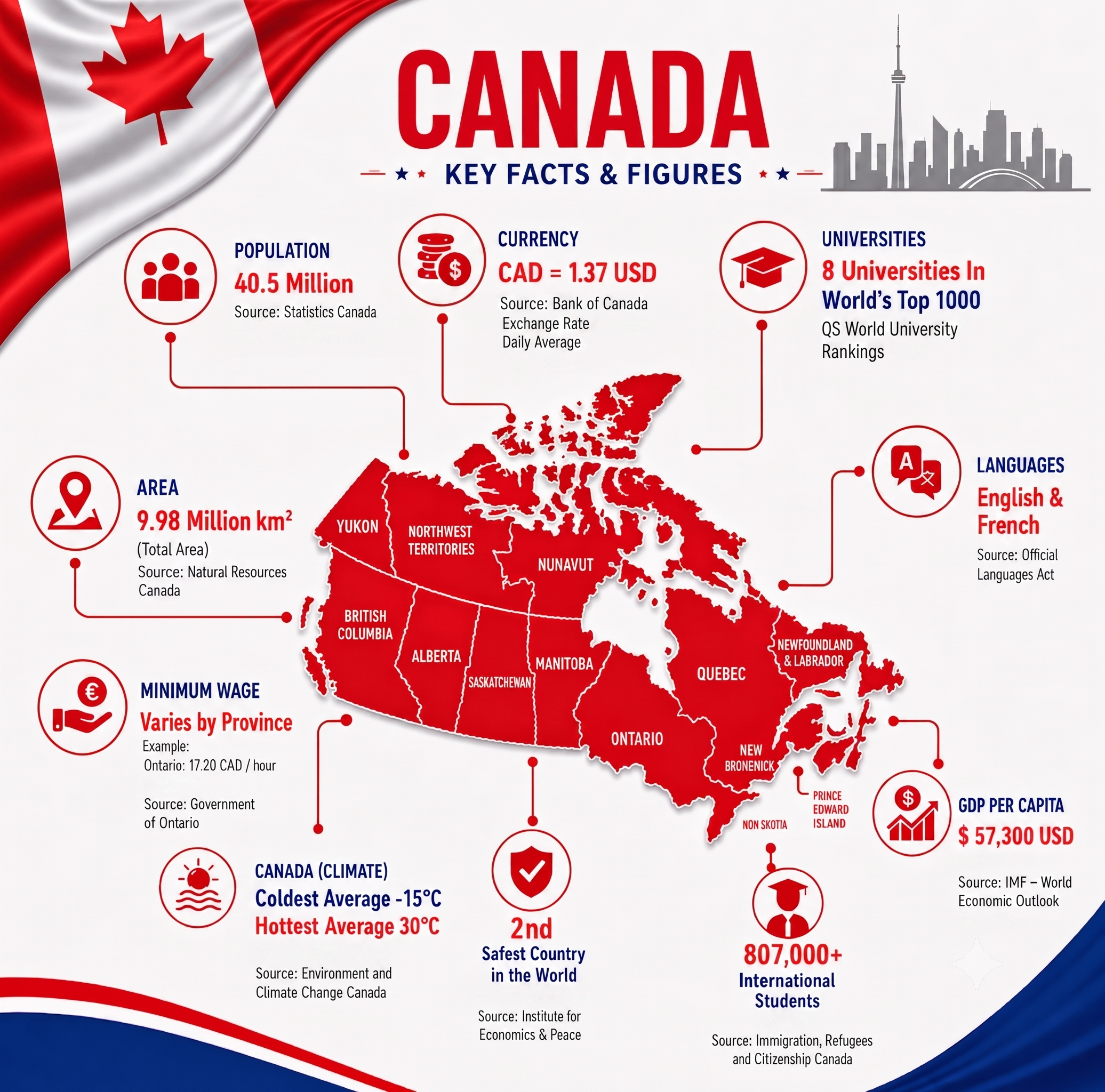
Canada is a North American country made up of ten provinces and three territories. It stretches from the Atlantic Ocean to the Pacific Ocean and extends northward into the Arctic region. Canada is the second-largest country in the world by total area and shares the longest international land border with the United States.

The country is officially bilingual, with English and French as its official languages, and is known globally for its multicultural and welcoming environment. Canada has a population of over 40 million people and maintains one of the world’s strongest economies supported by natural resources, innovation, trade, and advanced industries.

Canada is consistently ranked among the best countries in the world for quality of life, education, safety, and career opportunities. International students benefit from excellent academic standards, practical learning, and post-study work opportunities.

Why Choose Canada?

  • World-class universities and colleges with globally recognized degrees.
  • Affordable tuition fees compared to many other countries.
  • Safe, peaceful, and multicultural society.
  • Excellent post-study work and immigration opportunities.
  • Strong Indian communities including Punjabi, Gujarati, and South Indian populations.
  • High literacy rate and one of the best education systems in the world.
  • Part-time work opportunities for international students.
  • Innovative research and career-focused education programs.
  • Intakes available in September, January, and May.
  • High quality of life and excellent healthcare facilities.

Quick Facts About Canada

Capital City Ottawa
Largest City Toronto
Official Languages English & French
Currency Canadian Dollar (CAD)
Population Approx. 40 Million
Minimum Wage Approx. $17.30 CAD per hour*
Major Intakes September, January & May
Literacy Rate 99%
Internet Domain .ca

Popular Cities in Canada

Canada is home to many vibrant and student-friendly cities offering excellent education and employment opportunities. Popular cities include:

  • Toronto
  • Vancouver
  • Montreal
  • Ottawa
  • Calgary
  • Edmonton
  • Winnipeg
  • Halifax
  • Saskatoon
  • Regina
  • Kitchener-Waterloo

Weather in Canada

Season Duration Climate
Summer June to August Warm to hot weather with temperatures between 20°C to 30°C.
Autumn September to November Cool weather with frequent rain and pleasant climate.
Winter December to February Very cold temperatures with snowfall in many regions.
Spring March to May Pleasant weather with cool mornings and evenings.

Top Metropolitan Areas

City Province Population
Toronto Ontario 6.47 Million
Montreal Quebec 4.31 Million
Vancouver British Columbia 2.69 Million
Calgary Alberta 1.51 Million
Ottawa-Gatineau Ontario / Quebec 1.44 Million
Edmonton Alberta 1.44 Million

Why Students Choose Canada for Study Abroad

Canada is one of the leading destinations for international students because of its globally recognized education system, affordable tuition fees, multicultural environment, and excellent career opportunities after graduation.

Top Reasons to Study in Canada

  • Qualifications valued around the world
  • Affordable education
  • Multicultural society
  • Healthy and safe communities
  • World-class language education
  • Exciting campus lifestyle
  • Innovative research opportunities
  • Work opportunities during study
  • Post-study work permit options
  • Possibility of immigration

Qualifications Valued Around the World

Canada’s high academic standards and strict quality controls ensure that students receive globally recognized qualifications. Canadian degrees, diplomas, and certificates are respected worldwide and provide strong career opportunities in many countries.

Affordable Education

Canada offers high-quality education at comparatively affordable tuition fees and living costs. Compared to countries like the United States and the United Kingdom, students can access excellent academic programs and modern facilities at a more reasonable cost.

Multicultural Society

Canada is known for its multicultural environment where people from different cultures, religions, and backgrounds live together peacefully. International students can easily find cultural communities, food, festivals, and activities that make them feel at home.

Healthy and Safe Communities

Canada is consistently ranked among the safest countries in the world. International students enjoy a peaceful environment, high living standards, quality healthcare facilities, and equal rights that contribute to a comfortable and secure lifestyle.

World-class Language Education

Canada is officially bilingual with English and French as its official languages. Students can improve their communication skills while studying in a globally recognized educational environment that supports language learning and development.

Exciting Campus Lifestyle

Canadian universities and colleges provide modern campuses with advanced technology, sports facilities, libraries, student clubs, and cultural activities. Students can enjoy an engaging and active lifestyle while building valuable connections and experiences.

Innovative Research Opportunities

Canada is recognized for its research and innovation in areas such as medicine, environmental science, engineering, computer technology, and agriculture. Students can participate in advanced research projects supported by government and industry investments.

Work While Studying

International students studying full-time at a Designated Learning Institution (DLI) can work while studying in Canada. This allows students to gain work experience and support their living expenses.

  • Up to 24 hours per week during study terms
  • Full-time during scheduled breaks and holidays
  • On-campus and off-campus work opportunities available

Most students do not require a separate work permit for working during their studies.

Post Study Work Permit

  • Students completing a 1-year course may receive up to a 1-year work permit.
  • Students completing programs of 2 years or more may receive up to a 3-year work permit.
  • The Post-Graduation Work Permit allows graduates to gain valuable Canadian work experience.
  • Students can begin another program within 150 days after completing their previous studies.

Possibility of Immigration

International students with Canadian qualifications and work experience may become eligible for permanent residency through various immigration pathways. Canada provides excellent opportunities for students who wish to build a long-term future in the country.

Have Questions?

Visit our Frequently Asked Questions page or contact us directly for complete guidance about studying in Canada.

Imagine studying and building your future in Canada.

Universities & Colleges in Canada

Canada is home to some of the world’s leading universities and colleges offering globally recognized qualifications, excellent academic facilities, innovative research opportunities, and career-focused education programs for international students.

Canadian Top Universities

SR No. University QS Ranking 2024 QS Ranking 2023
1 University of Toronto 21 25
2 McGill University 30 29
3 University of British Columbia 34 38
4 University of Montreal 141 159
5 University of Alberta 111 96
6 McMaster University 189 176
7 University of Waterloo 112 115
8 Western University 114 120
9 University of Ottawa 203 189
10 University of Calgary 182 198

Institutes in British Columbia

SR No. University Name City
1Acsenda School of ManagementVancouver
2Arbutus CollegeVancouver
3Camosun CollegeVictoria
4Capilano UniversityNorth Vancouver
5College Of New CaledoniaPrince George
6College of the RockiesCranbrook
7Douglas CollegeNew Westminster
8Fairleigh Dickinson UniversityVancouver
9Kwantlen Polytechnic UniversitySurrey
10North Island CollegeCourtenay
11Northern Lights CollegeDawson Creek
12NYITVancouver
13Royal Roads UniversityVictoria
14Selkirk CollegeCastlegar
15Thompson River UniversityKamloops

Institutes in Ontario

SR No. University Name City
1Algonquin CollegeOttawa
2Brock UniversitySt. Catharines
3Cambrian CollegeSudbury
4Centennial CollegeToronto
5Conestoga CollegeKitchener
6Fanshawe CollegeLondon
7George Brown CollegeToronto
8Georgian CollegeBarrie
9Humber CollegeToronto
10Seneca CollegeToronto
11Sheridan CollegeOakville
12Western UniversityLondon

Institutes Across Other Provinces

Canada offers excellent educational institutions across multiple provinces including Alberta, Quebec, Manitoba, Saskatchewan, Nova Scotia, New Brunswick, and Prince Edward Island.

Province Popular Institutes
Quebec Lasalle College International, Herzing College, Cegep College
Alberta Bow Valley College, NAIT, SAIT, University of Lethbridge
Manitoba University of Manitoba, University of Winnipeg, RRC Polytechnic
Saskatchewan Saskatchewan Polytechnic, University of Regina, University of Saskatchewan
New Brunswick Crandall University, St. Thomas University
Nova Scotia Dalhousie University, Cape Breton University, Acadia University
Other Places Yukon University, Memorial University of Newfoundland, University of Prince Edward Island

Find the Right University for Your Future

Explore top universities and colleges across Canada and choose the institution that best matches your academic goals, career plans, and preferred study destination.

Course Information

Canada attracts thousands of international students every year with its flexible education system, globally recognized qualifications, practical learning approach, and excellent career opportunities across multiple industries.

Top Courses to Study in Canada

Course Type Duration
Diploma 2 Years
Advanced Diploma 3 Years (with Co-Operative Education)
Post Graduate Program 1 to 2 Years
Bachelor Degree 4 Years
Master Degree 2 Years

Minimum IELTS Requirement

Program Type IELTS Requirement
Advanced Diploma & Diploma Overall 6.0 Bands with no module less than 5.5
Post Graduate & Degree Courses Overall 6.5 Bands with no module less than 6.0

Electrical & Electronics Programs

Electronics Engineering Technology, Fire Safety Systems, Power Line Techniques, Electro Mechanical Engineering, Renewable Energy Systems, Mechanical Millwright, Electro Mechanical Engineering – Robotics, Power Engineering, and many more career-oriented technical programs.

Computer & IT Programs

Computer System Technician, Computer Information Security, Cloud Computing, Information System Security, Computer Programmer, Computer Program Analyst, Database Application Development, Computer Engineering, Information Solutions, Artificial Intelligence, Cyber Security, and many more.

Mechanical Engineering Programs

Mechanical Engineering Technician & Technology, Manufacturing Engineering, Mechanical Millwright, Heat & Refrigeration, Energy Systems Engineering Technology, Embedded System Engineering Design, Industrial Automation, CAD Designing, and many more.

Management Programs

International Business Management, Global Business Management, Project Management, Accounting, Finance, Marketing, Public Relations, Human Resource Management, Supply Chain Management, Hospitality Management, and many more business-focused programs.

Chemical Engineering Programs

Chemical Engineering Technician & Technology, Chemical Laboratory Technician, Petroleum Engineering, Environmental Engineering Applications, Environmental Management, Environmental Science Technician, Industrial Chemical Processes, and many more.

Pharmacy & Biotechnology Programs

Pharmacy Technician, Community Pharmacy Assistance, Regulatory Affairs & Quality Control, Biotechnology, Pharmaceutical Sciences, Chemical Laboratory Technician, Clinical Research, and many more healthcare-related programs.

Physiotherapy & Fitness Programs

Physiotherapy Assistance, Fitness & Health Promotion, Therapeutic Recreation, Exercise Science, Wellness & Lifestyle Management, Rehabilitation Support, and many more health and fitness programs.

Dental Programs

Dental Hygiene, Dental Assistance, Dental Restoration, Dental Office Administration, Denturist Programs, Oral Health Care, and several practical dental science programs designed for clinical careers.

Health Care Programs

Canadian Health Care System, Health Informatics, Health Science, Public Health, Nursing Pathways, Medical Office Administration, Personal Support Worker Programs, and many other healthcare-focused programs with strong employment opportunities.

Choose the Right Course for Your Career

Explore a wide range of diploma, degree, postgraduate, and professional programs in Canada and build a successful international career with globally recognized qualifications.

Eligibility Criteria

International students planning to study in Canada must meet basic academic and English language proficiency requirements depending on their chosen course and institution.

Academic Eligibility

  • Students who have completed Grade 12th in any stream are eligible to apply for diploma, advanced diploma, and bachelor degree programs.
  • Graduates from recognized universities can apply for postgraduate diploma, master’s degree, and specialized professional programs.
  • Admission requirements may vary depending on the university, college, and selected course.

Accepted English Language Tests

Canadian institutions accept internationally recognized English language proficiency tests for admission purposes:

  • IELTS Academic
  • TOEFL iBT
  • PTE Academic
Test Name Minimum Overall Score
IELTS Academic Overall 6.0 Bands
PTE Academic Overall Score of 60
TOEFL iBT Overall Score of 83

Important Note

Eligibility requirements may vary depending on the course, institution, and province. Some universities and colleges may require higher academic percentages or English language scores for specific programs.

Student Accommodation in Canada

International students in Canada can choose between on-campus and off-campus accommodation options based on their lifestyle, budget, and personal preferences. Both options offer comfortable living environments with easy access to educational facilities and essential services.

On-Campus Housing

Many colleges and universities in Canada offer accommodation facilities located on or near campus. These include dormitories, residence halls, townhouses, and student apartments designed to provide a convenient and secure living experience for students.

Dormitories are larger buildings that accommodate multiple students and usually include shared kitchens, bathrooms, laundry facilities, and common recreational areas. Many residence halls also offer meal plans through campus dining halls.

Townhouses generally accommodate three to six students with individual bedrooms and shared living spaces such as kitchens and living rooms. These accommodations are commonly preferred by senior students.

Most first-year and second-year students prefer staying on campus because it helps them adapt quickly, make new friends, and reduce transportation expenses.

Features of On-Campus Housing

  • Convenient access to classrooms and campus facilities
  • Shared kitchen, laundry, and bathroom facilities
  • Meal plan options available in many residences
  • Safe and student-friendly environment
  • Opportunity to socialize and build friendships
  • Lower transportation expenses

Average Cost

The average cost of on-campus accommodation in Canada ranges between $3,000 to $7,500 CAD per academic year depending on the institution, room type, and facilities provided.

Off-Campus Housing

Students who prefer more independence often choose private off-campus accommodation. Universities and colleges usually provide support through housing offices or student unions to help students find nearby rental properties.

Off-campus housing options include shared houses, apartments, private rooms, and rental suites. Since renting an entire house can be expensive, many students choose to share accommodation with roommates to reduce living expenses.

Most rental properties in Canada are unfurnished, and students are usually required to sign a lease agreement that outlines their rights and responsibilities as tenants.

Important Rental & Lease Information

  • Students must carefully read lease agreements before signing.
  • Tenants are responsible for paying rent on time and maintaining cleanliness.
  • Students should always keep copies of signed documents.
  • Landlords are responsible for maintaining the property in good condition.
  • Advance notice is generally required before entering rented premises.
  • In many cases, landlords provide at least 60 days’ notice before asking tenants to vacate.

Average Monthly Cost

Off-campus accommodation costs in Canada generally range from C$400 to C$1,500 per month depending on the city, neighborhood, room type, and whether accommodation is shared with roommates.

Find the Right Student Accommodation

Whether you choose on-campus residence or private off-campus housing, Canada offers safe, comfortable, and student-friendly accommodation options to suit different budgets and lifestyles.

All About Intakes in Canada

Canadian universities and colleges offer multiple study intakes throughout the year, providing international students with flexible admission opportunities based on their academic plans and course availability.

Major Intakes in Canada

Intake Starts In Details
Fall Intake September Primary intake with maximum course availability and highest number of student admissions.
Winter Intake January Secondary intake with selected course options for students who missed the Fall intake.
Spring Intake May Limited intake with fewer universities and courses available for international students.

Fall Intake in Canada

Fall Intake is also known as the September Intake and is considered the primary intake in Canada. Most universities and colleges offer the highest number of programs and seats during this session.

International students generally prefer the Fall Intake because of greater course availability, scholarship opportunities, campus activities, and smoother admission processes.

The weather during the fall season is usually pleasant compared to the colder winter months, making it easier for new students to settle into Canadian life.

Winter Intake in Canada

Winter Intake is also known as the January Intake. It acts as a secondary admission period for students who were unable to apply during the Fall Intake.

Although fewer institutions and courses are available compared to the September Intake, many colleges and universities still offer excellent academic programs during this session.

Students choosing the Winter Intake should prepare for colder weather conditions, as January is one of the coldest months in Canada.

Spring Intake in Canada

Spring Intake is also referred to as the May Intake or Summer Intake in Canada.

This is the least preferred intake because only a limited number of colleges and universities offer courses during this period.

Students applying for the Spring Intake should check course availability carefully, as program options are comparatively fewer than the Fall and Winter Intakes.

Choose the Best Intake for Your Study Plan

Selecting the right intake depends on your preferred course, university deadlines, visa processing time, and academic goals. Planning early can help you secure better admission and scholarship opportunities in Canada.

Admission Procedure for Canada

International students planning to study in Canada must follow a structured admission process that includes selecting the right course, preparing documents, applying to colleges or universities, and completing visa formalities.

Follow the Process for Securing Admission

  1. Select your preferred course, college, or university in Canada.
  2. Prepare all academic and supporting documents required for admission.
  3. Complete English language proficiency requirements such as IELTS, TOEFL, or PTE.
  4. Submit the admission application to the selected institution.
  5. Receive the offer letter or letter of acceptance from the institution.
  6. Pay tuition fees or deposit amount as required by the institution.
  7. Apply for the Canadian study permit and visa process.

Mandatory Documents for Admission

Students must prepare the following documents while applying for colleges or universities in Canada:

  • Passport Copy
  • 10th Marksheet
  • 12th Marksheet with Passing Certificate
  • Bachelor’s Marksheet
  • University Transcripts (for University Applications)
  • Degree Certificate or Provisional Certificate
  • Work Experience Documents (if applicable)
  • IELTS TRF / English Test Score Card
  • Letter of Recommendation (LOR) for University Applications
  • Statement of Purpose (SOP) – Optional
  • CV / Resume (for experienced applicants)
  • Birth Certificate in English (required for Quebec applications)
  • No Backlog Certificate or Certificate Mentioning Number of Backlogs

All About Intakes & Application Timings

Intake Session Semester Start Date Application Deadlines
Fall Intake September January – March
Winter Intake January September – November
Summer / Spring Intake May December – February

Apply Early for Better Opportunities

Students are advised to begin the admission process at least 6 to 12 months before their preferred intake to ensure enough time for university applications, visa processing, financial preparation, and accommodation arrangements.

Cost of Study in Canada

Canada is considered one of the most affordable destinations for international students seeking world-class education, excellent career opportunities, and high-quality living standards.

Estimated Expenses for Studying in Canada

The total cost of studying in Canada depends on the course, institution, city, and lifestyle of the student. The table below provides an approximate yearly budget for international students planning to study in Canada.

Details Approx. Cost (CAD) Approx. Cost (INR)
Application Fees $50 – $150 ₹6,700/-
Tuition Fees $18,000 – $25,000 ₹12,06,000/-
GIC Deposit $22,895 ₹15,34,000/-
Medical Fees Approx. ₹7,000/-
Visa Fees $150 ₹10,000/-
Biometric Fees $85 ₹5,700/-
Air Tickets $1,600 ₹1,00,000/-
Approx. Total Cost $42,800 ₹28,69,400/-

Important Notes

  • Tuition fees vary depending on the course, institution, and province.
  • Living expenses may differ based on the city and personal lifestyle.
  • Currency exchange rates may change over time.
  • Students are advised to keep additional funds for accommodation, food, transport, and emergency expenses.
  • Scholarships and part-time work opportunities can help reduce the overall cost of studying in Canada.

Plan Your Budget for Canada

Proper financial planning helps international students manage tuition fees, living expenses, and visa costs efficiently while studying in Canada.

Scholarships for International Students

Canada offers various scholarship opportunities for international students based on academic performance, leadership qualities, research potential, and financial need.

Scholarship Application Procedure

The application process may vary depending on the scholarship provider and institution. However, most scholarship applications generally include the following steps:

  • Completing the scholarship application form
  • Writing an essay or research proposal
  • Providing proof of academic achievements
  • Submitting English language proficiency test scores
  • Attaching employment or work experience documents if required
  • Uploading all required academic and supporting documents
  • Participating in interviews or entrance tests if applicable
  • Monitoring updates in scholarship requirements and government policies

Useful Scholarship Resources

Explore the following websites for scholarship opportunities and updated information about studying in Canada:

Documents Required for University Applications

  • Academic Mark Sheets and Transcripts from Class 10th onwards
  • English Proficiency Test Results such as IELTS, TOEFL, or PTE
  • Updated Resume or CV including education, skills, goals, and work experience
  • Educational Credential Assessment (if required)
  • Statement of Purpose (SOP)
  • Letter of Recommendation (LOR) from professors or employers
  • SAT, GRE, or GMAT scores if required by the institution

Difference Between University & College in Canada

University College
Admission process is comparatively detailed Admission process is comparatively easier
Application process may take more time Faster and simpler application process
Tuition fees generally range from 20,000 CAD to 35,000 CAD Tuition fees generally range from 12,000 CAD to 18,000 CAD
Higher IELTS / TOEFL / PTE scores may be required Moderate IELTS / TOEFL / PTE scores accepted
SOP and LOR are commonly required SOP and LOR may not always be required
Focus on research and theoretical studies Focus on practical and skill-based education
Some programs may require previous experience Experience usually not required
GRE / GMAT / SAT scores may be required GRE / GMAT / SAT generally not required

Explore Scholarships & Admission Opportunities

Proper planning, accurate documentation, and early scholarship applications can help international students reduce educational expenses and improve admission opportunities in Canada.

Work Permit in Canada

Canada provides excellent opportunities for international students to work during their studies and gain valuable international work experience after graduation through post-study work permit programs.

Work While Study

The option to work while studying is one of the major reasons why international students choose Canada as their study destination. Students enrolled in full-time programs at Designated Learning Institutions (DLIs) can legally work while studying.

International students are generally allowed to work up to 24 hours per week during regular academic sessions and full-time during scheduled breaks such as summer vacations and winter holidays.

In most cases, students do not require a separate work permit to work on-campus or off-campus while holding a valid Canadian study permit.

Work on Campus

Students can begin working in Canada only after starting their academic program and if their study permit includes permission to work on-campus or off-campus.

“On-campus” work refers to employment opportunities available within the college or university campus, including all buildings and facilities associated with the institution.

If a college or university has multiple campuses, students are generally permitted to work only at the campus where they are officially enrolled and studying.

Post Study Work Permit (PGWP)

International students who successfully complete eligible programs in Canada may qualify for a Post-Graduation Work Permit (PGWP), allowing them to gain Canadian work experience after completing their studies.

Study Duration Possible Work Permit Duration
1 Year Program Up to 1 Year Work Permit
2 Year or 4 Year Program Up to 3 Years Work Permit

Important PGWP Requirements

  • The program must be completed from a Designated Learning Institution (DLI).
  • Students must maintain full-time student status during each semester of study.
  • PGWP applications must be submitted within 180 days after graduation.
  • The study permit must remain valid at some point during the 180-day period after graduation.
  • Certain college programs must fall under the approved CIP 2021 codes list.
  • Canada encourages students to pursue programs related to STEM fields such as Science, Technology, Engineering, and Mathematics.
  • University graduates generally require a minimum CLB 7 language proficiency.
  • College graduates generally require a minimum CLB 5 language proficiency.

Post Study Work Visa

Graduates who complete bachelor’s, master’s, or doctoral degree programs from eligible Canadian universities may receive up to 3 years of post-study work authorization.

Students graduating from eligible college programs under the approved CIP list may receive work permits based on the duration of their studies.

  • 1 Year Study Program → Up to 1 Year Work Permit
  • 2 Year Study Program → Up to 3 Years Work Permit

Possibility of Immigration

International students with Canadian educational qualifications and Canadian work experience may become eligible to apply for permanent residency in Canada.

Canada offers several immigration pathways for skilled graduates who wish to build their careers and settle permanently after completing their education.

Build Your Career in Canada

Studying in Canada not only provides quality education but also creates opportunities for work experience, long-term career growth, and potential permanent residency pathways.

Canada Student Visa Fees

International students applying for a Canadian Study Permit must pay the required visa application and biometric fees at the time of submitting their visa application.

Student Visa (Temporary Resident Visa)

Students must pay the official visa fees while submitting their Canadian student visa application. The visa fee and biometric fee are mandatory for most international applicants.

Student Visa Fee: CAN$150 (Approx. ₹10,000)

Biometric Fee: CAN$85 (Approx. ₹5,700)

Visa & Biometrics Fee Structure

Application Type Fee (CAN$)
Student Visa $150
Biometrics (Per Person) $85
Total $235

Follow the Steps for Achieving a Canada Student Visa

  1. Select your course and receive an offer letter from a Designated Learning Institution (DLI).
  2. Arrange all required academic, financial, and personal documents.
  3. Complete your tuition fee payment and GIC process if applicable.
  4. Prepare your Statement of Purpose (SOP) and supporting documents.
  5. Submit your online Canadian student visa application.
  6. Pay the visa application and biometric fees.
  7. Schedule and complete your biometrics appointment.
  8. Wait for visa processing and receive your final decision from Immigration, Refugees and Citizenship Canada (IRCC).

Important Information

Visa fees and immigration policies may change over time. Students are advised to check the latest updates from official Canadian immigration authorities before submitting their applications.

Book Your Free Counselling Session


HOW WE HELP CLIENTS

Canada Visa Services We Offer

Whether you are applying from India or already in Canada, we support both offshore and onshore applications.

Vin Consultancy

Our Canada Visa Process

We follow a structured and transparent approach to maximize your chances of visa approval.

Profile Evaluation

We assess your eligibility based on education, experience, and CRS score

Visa Strategy

We recommend the best pathway (Express Entry, PNP, Work Permit, etc.)

Documentation

Complete support for accurate and strong documentation

Application Submission

Error-free and timely application filing

Approval & Guidance

Support until visa decision and post-landing guidance

apply-2

Start Your Canada Journey Today

Get expert guidance for your Canada visa and increase your chances of approval with Vin Consultancy.

Apply Visa Now
Talk with Visa Expert
Apply Visa Now
Overlay Image